
Uncategorized
Measure First: Dog Collar Size Chart and When to Choose a Custom Fit
Aug
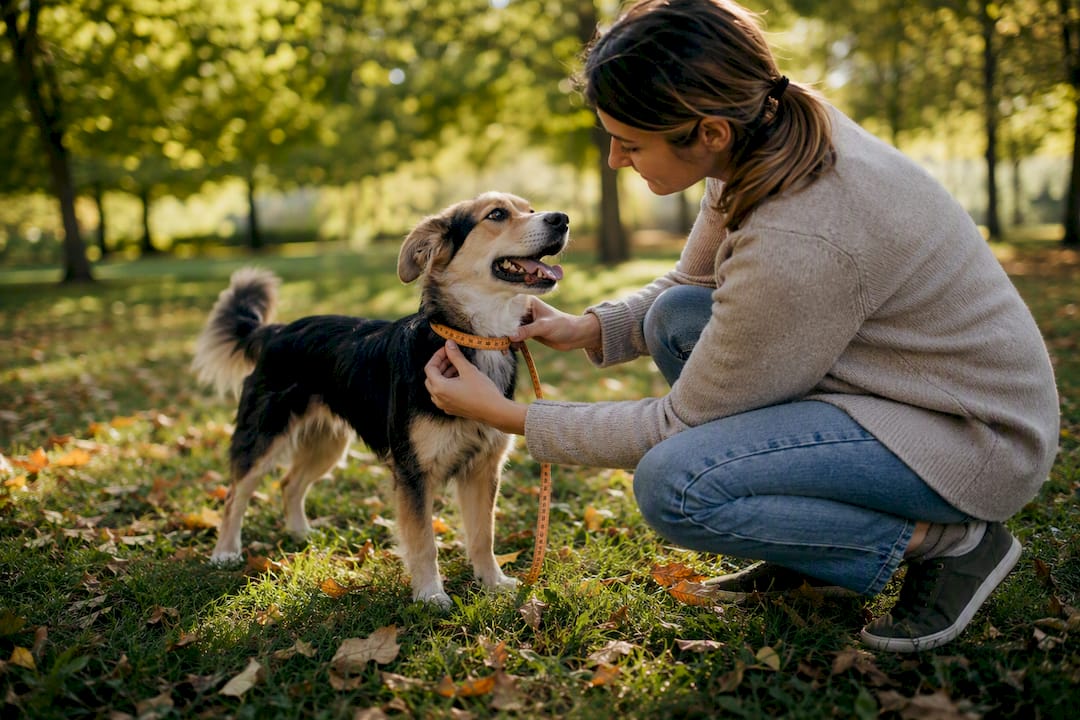
Measure your dog’s neck where the collar will actually sit, add about 2 inches for a comfortable two-finger fit, then match that number to a standard size band. Most collars fall into five bands: XS, S, M, L, and XL, each tied to a neck-inch range. Get the measurement right and the chart does the rest.
TL;DR:
- Accurate measurement of your dog’s neck and adding about two inches is crucial for selecting the right collar size and ensuring comfort and safety.
- Breed, weight, and body structure significantly influence the correct collar size, especially for mixed, large, or muscular breeds that may deviate from standard charts.
- Proper fit should allow two fingers to slide between the collar and the neck, with regular rechecks every few months or weeks depending on age and coat changes.
- Width and material of the collar matter; wider straps and durable hardware are necessary for larger, strong puller breeds to ensure safety and longevity.
- Custom-made leather collars built around precise measurements outperform standard sizes, especially for oversized or complex breed types, and reduce the risks associated with improper fitting.
Table of Contents
- Dog Collar Size Chart: Neck Ranges and Breed Examples
- How to Measure Your Dog’s Neck for a Collar
- What Size Collar Does a 20 Lb or 30 Lb Dog Need?
- Matching Collar Width and Material to Your Dog’s Size
- Common Dog Collar Sizing Mistakes to Avoid
- What Leather for Pets Learned Sizing Collars for Giant Breeds
- Flat Collars, Martingales, and Choke Chains: Sizing Isn’t the Same
- Adjustable vs. Fixed-Size Collars: Different Measuring Approach
- Collar Fit Safety: Signs It’s Too Tight or Too Loose
- What Actually Matters When Sizing a Collar
- Order a Custom-Sized Leather Collar From Leatherforpets
- Sources
Dog Collar Size Chart: Neck Ranges and Breed Examples
A dog collar sizing chart works off one number: the neck circumference where the collar rests, plus your comfort allowance. Once you have that figure, matching it to a size band takes seconds.
Here’s the breakdown most retailers and collar makers use, based on standard size bands that run from XS through XL:
- XS (6″–10″): Toy breeds like Chihuahuas, Yorkshire Terriers, and small Dachshunds. Think 4 to 8 pounds.
- S (10″–14″): Beagles, Cocker Spaniels, French Bulldogs on the smaller side. Roughly 15 to 30 pounds.
- M (14″–20″): Border Collies, Bulldogs, and many Labradors in the 30 to 50 pound range. Most 30 to 40 pound dogs land here, assuming a typical build.
- L (18″–26″): German Shepherds, Boxers, and Golden Retrievers, usually 50 to 80 pounds.
- XL (22″–30″): Mastiffs, Great Danes, Presa Canarios, and other giant breeds over 80 pounds.
Notice the overlap between M and L, and between L and XL. That’s intentional. Collar makers build in slack because dogs at the same weight can have wildly different neck sizes depending on bone structure and coat thickness. A stocky Bulldog and a lean Greyhound might both weigh 50 pounds, but their necks won’t match.
Mixed breeds throw another wrinkle into the mix. A rescue labeled “Lab mix” could have a neck anywhere from 16 to 22 inches depending on what’s actually in the mix. Charts give you a starting point, never a substitute for your own tape measure.
How to Measure Your Dog’s Neck for a Collar
Getting an accurate number takes about two minutes and one trip around your dog’s neck with a soft tape measure.
- Position the tape high on the neck, right behind the ears where a collar naturally sits when your dog is standing normally. Collars that ride too low near the shoulders will measure differently and throw off your sizing.
- Wrap snugly but not tight. The tape should sit flush against fur without compressing it.
- No tape measure? Use a string or ribbon, wrap it around the same spot, mark where it meets, then lay it flat against a ruler.
- Write down the raw number. This is your dog’s actual neck circumference, not the finished collar size yet.
- Add roughly 2 inches to that number. This is the industry-standard two-finger rule: once buckled, you should be able to slide two fingers flat between the collar and your dog’s neck.
- Match the adjusted number to the chart above to pick your size.
Chain slip collars and prong collars are the exception. Coastal Pet’s own sizing guidance recommends adding closer to 4 inches for these styles instead of 2, since they function differently and need extra length to operate correctly and safely.
Pro Tip: Measure puppies every four to six weeks during their growth spurt. A collar that fits perfectly in March can be uncomfortably tight by May.
What Size Collar Does a 20 Lb or 30 Lb Dog Need?
Weight gives you a rough starting point, but it’s the second-best data point you have, not the first. Two dogs at the same weight can need different size bands entirely.
That said, here’s what tends to hold true across common weight brackets:
- 10 lb dogs (Chihuahua, Pomeranian, small terrier mixes): usually XS, neck around 8 to 10 inches.
- 20 lb dogs (Beagle, Cocker Spaniel, Corgi): typically S to M, neck around 12 to 15 inches.
- 30 lb dogs (Border Collie, Australian Shepherd, small Pit Bull mix): commonly M, with most 30 to 40 pound dogs fitting the 14 to 18 inch range.
- 40 to 60 lb dogs (Labrador, Boxer, Bulldog): M to L depending on chest and neck build.
- 60 to 90 lb dogs (German Shepherd, Rottweiler, Doberman): usually L.
- 90+ lb dogs (Mastiff, Great Dane, Presa Canario, Saint Bernard): XL, often at the upper edge of that range or beyond it.
Broad-chested, thick-necked breeds throw weight-based estimates off constantly. A 30 pound French Bulldog often needs a bigger neck size than a 30 pound Whippet, because Bulldogs carry muscle and looseness around the neck that Whippets simply don’t have. Retailer sizing charts consistently point back to measuring over guessing by breed, and for good reason: breed lists are averages, and your dog is an individual.
Matching Collar Width and Material to Your Dog’s Size
Neck size tells you the length you need. Width and material determine whether the collar holds up to how your dog actually lives.
Width scales with weight and strength, not just size band:
- Under 10 lb: 3/8″ to 1/2″ wide. Anything wider looks disproportionate and can chafe smaller necks.
- 10 to 25 lb: 1/2″ to 3/4″ wide, enough for daily wear without overwhelming a smaller frame.
- 25 to 60 lb: 3/4″ to 1″ wide, the sweet spot for most medium and large dogs on standard walks.
- 60+ lb or strong pullers: 1″ to 1.5″ or wider. Wider straps distribute leash pressure across more surface area, which matters a lot for dogs that lunge or pull hard.
Material matters just as much as width. Nylon and biothane resist water and cost less upfront, but they flex and stretch over time, which can slowly change your fit. Vegetable-tanned leather molds to your dog’s neck instead of stretching away from it, and it holds shape through years of wear, rain, and mud. When you’re shopping, check the hardware too. Solid brass or stainless steel D-rings, riveted (not just glued) attachment points, and reinforced stitching at the stress points all separate a collar that lasts from one that snaps at the worst moment.
Common Dog Collar Sizing Mistakes to Avoid
The single biggest mistake owners make is buying by weight alone and skipping the tape measure entirely. Weight charts are a starting guess, not a final answer.
The second mistake: ignoring the collar’s actual adjustment range. Every collar has a minimum and maximum hole or buckle setting, and if your measurement sits near either extreme, you have almost no room to fine-tune the fit later.
- Always measure neck circumference directly, even if you already know your dog’s breed and weight.
- Check both ends of a collar’s adjustable range before buying, not just the size label.
- If your number falls right between two sizes, size up if you prefer a looser everyday fit, or size down slightly if the collar has generous adjustment room built in.
- For puppies, buy adjustable collars or plan to replace the collar every few months during growth. Buying an oversized collar “to grow into” creates a real slip-out risk in the meantime.
Pro Tip: If your dog’s measurement lands within an inch of a size cutoff, buy the larger size when the collar is fixed and non-adjustable. It’s easier to add a hole than to return a collar that won’t buckle.
What Leather for Pets Learned Sizing Collars for Giant Breeds
Standard charts start falling apart the moment you’re fitting a Presa Canario or a Mastiff with a neck that doesn’t match anything on a typical size table. That’s the exact problem Leatherforpets built its process to solve: every collar gets sized to the individual dog, not to the nearest size band on a rack.
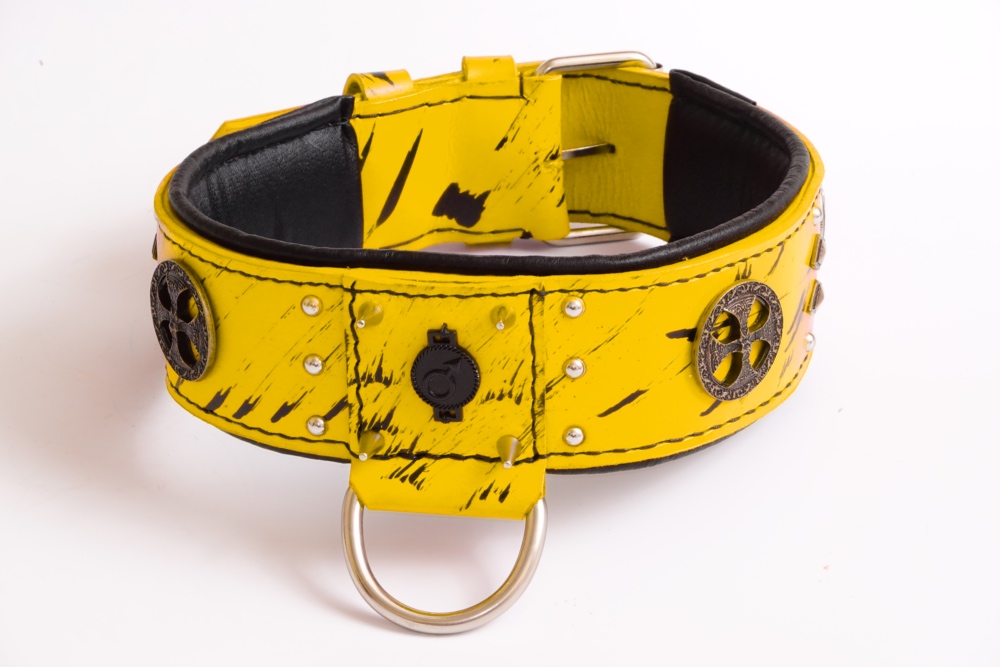
Wide-necked, muscular breeds need extra allowance beyond the standard two-finger rule, and heavy pullers do better with reinforced stitching and thicker hardware than a standard-width collar provides. When you order, Leatherforpets walks you through the same measure-and-add-2-inches method covered above, then builds the collar to that exact number instead of forcing your dog into a pre-cut size. For a deeper look at how that construction holds up over time, see how durable Leatherforpets collars are in daily use.
Flat Collars, Martingales, and Choke Chains: Sizing Isn’t the Same
Not every collar type sizes the same way, and using the flat-collar rule on a martingale or choke chain will get you a fit that’s either too loose to be safe or too tight to be comfortable.
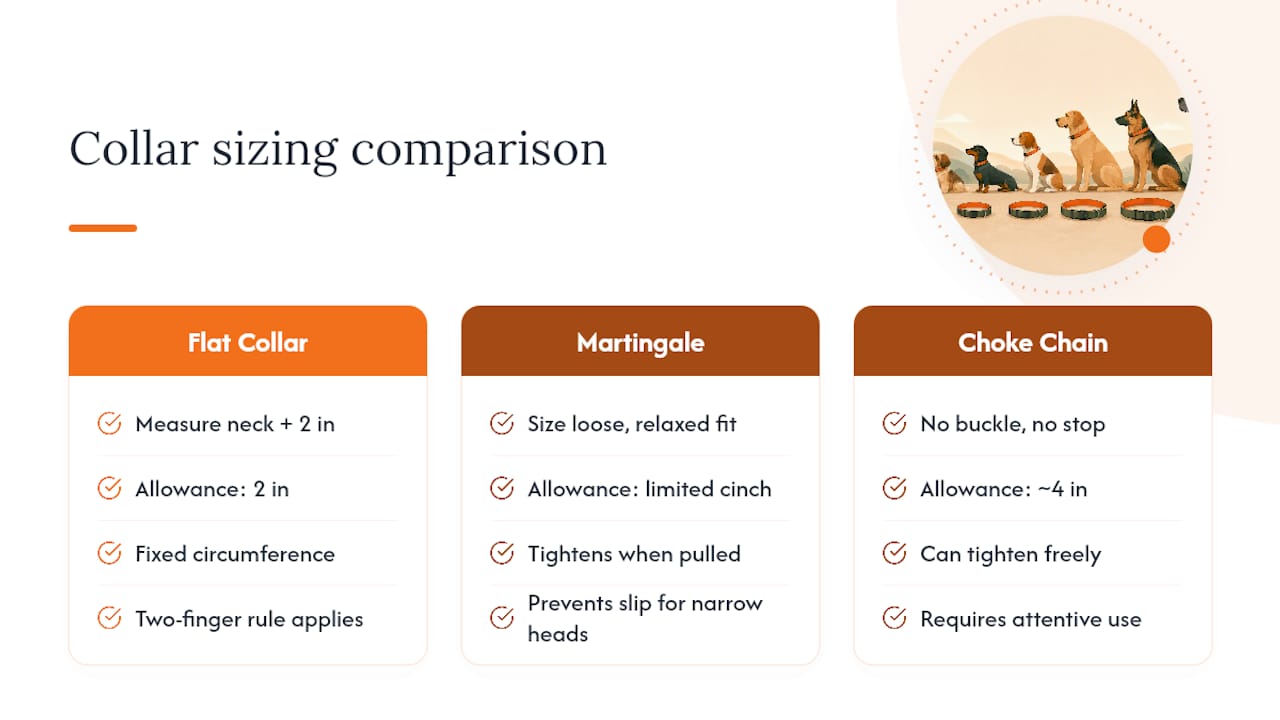
Flat collars are the simplest case: measure the neck, add 2 inches, done. They sit at a fixed circumference once buckled, so the two-finger rule applies directly.
Martingale collars are built to tighten slightly when a dog pulls back, which makes them popular for breeds with narrow heads that can slip out of flat collars, like Greyhounds and Whippets. Because they have a limited-cinch design, you size a martingale to fit loosely in its relaxed state, with enough room that it can tighten without choking, but not so much slack that it never engages.
Choke chains and slip collars work differently again. They have no buckle and no fixed stopping point, so Coastal Pet’s sizing guidance calls for roughly 4 inches of allowance instead of the standard 2. Too tight and the dog can’t get a full range of motion; too loose and the collar can slip completely over the head. These styles also demand more attentiveness during use since there’s no built-in limit on how far they can tighten.
If you’re unsure which type fits your training goals or your dog’s build, a flat leather collar sized with the standard method remains the safest default for everyday wear.
Adjustable vs. Fixed-Size Collars: Different Measuring Approach
Adjustable collars give you room to fine-tune the fit after the fact. Fixed-size collars don’t, which means your initial measurement has to be right the first time.
For an adjustable collar, measure your dog’s neck, add your 2-inch allowance, and choose whichever size band puts that number roughly in the middle of the collar’s adjustment range, not at either extreme. That middle position gives you slack to tighten as a puppy grows or loosen slightly if your adult dog gains a little weight.
For a fixed-size collar, precision matters more. There’s no buckle range to fall back on, so custom-made leather collars, like those from Leatherforpets, are built to your dog’s exact measurement rather than a generic size label. That’s part of why bespoke sizing works so well for breeds that don’t fit neatly into XS through XL, including Mastiffs and other giant breeds where even “XL” can vary by several inches between manufacturers.
One practical note: always measure again if you’re ordering a fixed-size collar for a dog you haven’t measured recently. Coat thickness changes seasonally, and a spring measurement can run an inch smaller than a winter one on heavily coated breeds.
Collar Fit Safety: Signs It’s Too Tight or Too Loose
A collar that fits wrong isn’t just uncomfortable. It’s a real safety issue, and the signs aren’t always obvious until you know what to check for.
Run the two-finger test regularly, not just at purchase. Slide two fingers flat between the collar and your dog’s neck; if you can’t fit them in, the collar’s too tight and could restrict breathing or rub the skin raw over time. If you can fit more than two fingers with room to spare, the collar’s loose enough to slip over the head, especially on narrow-skulled breeds during a sudden pull or panic moment.
Watch for physical signs beyond the finger test. Hair loss or matting under the collar, skin irritation, or a dog that scratches at its neck repeatedly all point to a fit problem worth addressing immediately. On the flip side, a dog that regularly escapes its collar during walks or backs out when startled needs a tighter fit or a different collar style altogether, sometimes a martingale instead of a flat collar.
Recheck the fit every few months for adult dogs and every few weeks for puppies. Weight changes, coat growth, and seasonal shedding all shift what “correct” looks like on the same dog.
What Actually Matters When Sizing a Collar
Most sizing guides treat the chart as the whole story. It isn’t. The chart is a lookup table; your tape measure is the actual data.
Here’s what the conventional advice gets wrong: it leans too hard on breed and weight as shortcuts, when those are just proxies for the one number that matters, which is neck circumference at the exact spot the collar sits. I’d go further than most guides do and say weight-based sizing should be treated as a rough sanity check at best, something you glance at after you measure, not something you measure by. The dogs that end up with genuinely wrong-fitting collars are almost always the ones sized off a breed chart instead of a tape measure.
The other underrated piece is width and hardware, which most articles bury under the neck-size discussion when it deserves equal billing. A perfectly sized collar with flimsy stitching or a thin D-ring on a 90 pound Mastiff is a bigger safety risk than a slightly loose collar with solid hardware. If you take one thing from all this, measure first, then think about what the collar is actually built to withstand for your specific dog.
— Dimitris
Order a Custom-Sized Leather Collar From Leatherforpets
Once you know your dog’s number, the next step is turning that measurement into a collar built specifically around it, not the nearest size on a rack. Leatherforpets makes every collar to order using premium vegetable-tanned leather, sized from toy breeds all the way up to giants that standard charts barely cover.
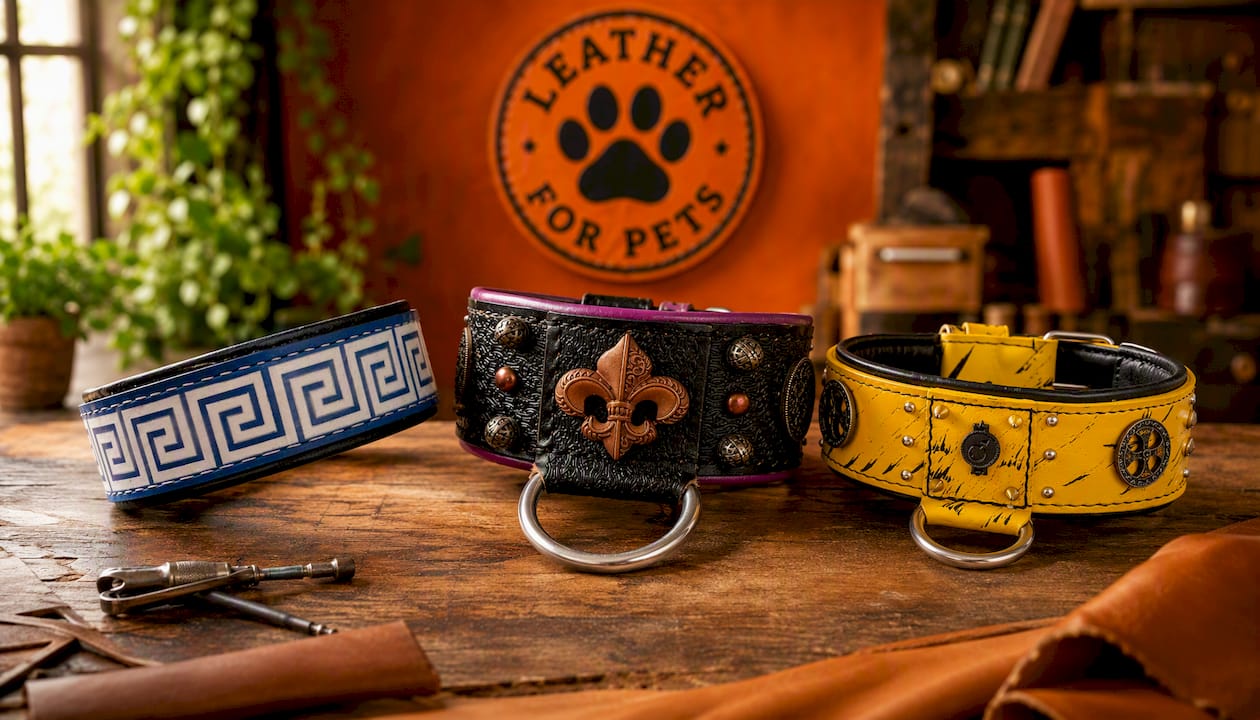
If you’ve got a smaller or midsize dog and want something with real personality, the Blue Greek Key leather collar is handmade and custom sized to your exact measurement, no rounding up to the nearest inch. For big, powerful breeds, the Big Mastiff tooled leather collar is built wide and reinforced for dogs that pull hard and need hardware that won’t give out. And if you own a Presa Canario, Cane Corso, or another muscular guardian breed, the Presa Canario collar shows exactly how Leatherforpets handles thick, powerful necks that generic size charts weren’t built for.
Enter your measured neck size at checkout, and Leatherforpets builds the collar around that number directly.
